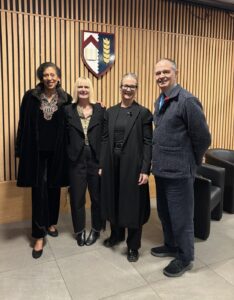
On the evening of the 11thNovember, Kellogg College Oxford University hosted a panel as part of their series of conversations on leadership. I was delighted to chair the panel and I am, very grateful to Jane Shepherdson, Cindy Forde and Ian MacLean for taking part and providing such an incisive and thought-provoking discussion. There will be a recording available in due course but in the mean-time I thought I would share the basis of my opening remarks.
“The overall topic for this Kellogg Conversation series is “leadership”. It has looked at founder leadership and succession and will be considering leadership in times of uncertainty and misinformation- how to navigate the need for trust and authenticity in times of crisis.
Fashion speaks to all these. We have founders- issues with succession and clearly issues with trust.
So, this panel topic of how we balance growth, responsibility and change is very pertinent
Here’s the dilemma:
If millions of people say they want a more sustainable fashion industry…
What needs to change so the industry can succeed and how do we lead to make it happen?
We don’t have a shortage of sustainable ideas. We do have a shortage of sustainable business models.
We know innovation alone won’t transform fashion if the businesses behind it can’t survive and if culturally, we don’t as consumers like them.
The panellists we have this evening are dedicated to making a more sustainable; and environmentally responsive industry so I expect the panel to touch on regulation, education, new business models and cultural change.
Before we start, I’d like to give the discussions a context.
Fashion is one of the few industries that everyone is part of. We all get dressed every day and the act of putting on and taking off clothes, adapting our clothes for the weather, for sleeping, our working conditions, is something we do without thinking. Our clothes can reflect our mental health; it is how we present ourselves to the world.
So, fashion has a reach most sectors can only dream of.
It has great cultural power if we don’t like something we won’t wear it. It also means that what fashion makes desirable can spread faster than any law or policy. So how are we using this power – how are fashion leaders, influencers and observers using this power?
For fashion is something we should have far more intent and concern for. We should care what we look like, we should consider where our clothes come from and we should know and be aware of what happens to them when we no longer need or want them.
Fashion has an extraordinarily negative environmental impact in a way that is completely disproportionate to our own individual choices.
We don’t see the impact, so we don’t care or think about the implications.
On water. On waste. On exploitation of people. On exploitation of natural resources.
It is an industry that runs on volume, speed and constant newness.
The commercial incentives and the environmental implications usually point in opposite directions.
We know there are far too many clothes in the world—and that this mountain of unwanted clothes is becoming ever bigger.
The consequence are clothes going to waste, ending up in landfills that negatively affect local communities and environments alike.
So, what can we do?
Surely leadership must be the key.
And that means our own leadership as consumers as well as the leadership across the diversity of the industry. This is what we must harness.
I hope that the discussions this evening will help us all as consumers to think about our own leadership responsibilities.”