In the run up to International Women’s Day I’ve been thinking about those women who have achieved much not just in their chosen field, but who have also influenced and inspired others. One such woman was Madame Gres. Alix Gres was an artist in the real sense of the world who dreamed of being a sculptor but after family pressure moved into fashion creating the haute couture house in 1933 with the associated Parfums Gres. She said about herself
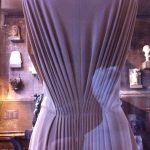
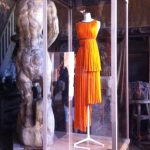

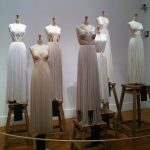
Her passion for sculpture and the human form is clear in her work. The beautiful wrapped and draped dresses with their Grecian resonance have influenced the development of fashion and fashion thinking. Whilst not as well known as other female fashion designers – Chanel, Schiaparelli, Miuccia Prada, Vivienne Westwood – her understanding of form is evident in those draped dresses that hide nothing.
Often potential fashion students think that fashion is more two‑dimensional than three‑dimensional, and that their drawings will be sufficient to create the structures necessary for clothing. But the reality of a designer’s work is to understand the human form and the construction required to allow movement, durability and presence (rewritten). In so many ways Madame Grès was a sculptor.
I have written in the past about how I consider Yohji Yamamoto an artist who expresses himself through fashion, and for me Madame Grès was the same. Yes, her family may have insisted that she pursue a more reliable creative outlet, but her feeling for form and creativity is clear to see and there is no sense of creative compromise.
I first encountered her work in a remarkable exhibition curated by Olivier Saillard in Paris in 2011. This exhibition not only deepened my appreciation of her work, but also made me reflect on the possibilities of exhibitions — particularly fashion exhibitions (rewritten). Madame Grès’ work was displayed amongst the work of the sculptor Antoine Bourdelle in his museum. This prolific French sculptor, who had studied under Rodin and whose sculptures have clear Romanesque influences, created pieces that are powerful and fluid in their forms.
Grès’ dresses were set among his sculptures — the contrast and tension between these two artists created a dynamic, inspiring and uplifting exhibition (rewritten). Not just because of the individual works and approaches, but because of the quality of the work. Madame Grès’ beautiful dresses and forms easily held their own in their delicacy and power.
For me, they outshone Bourdelle’s work