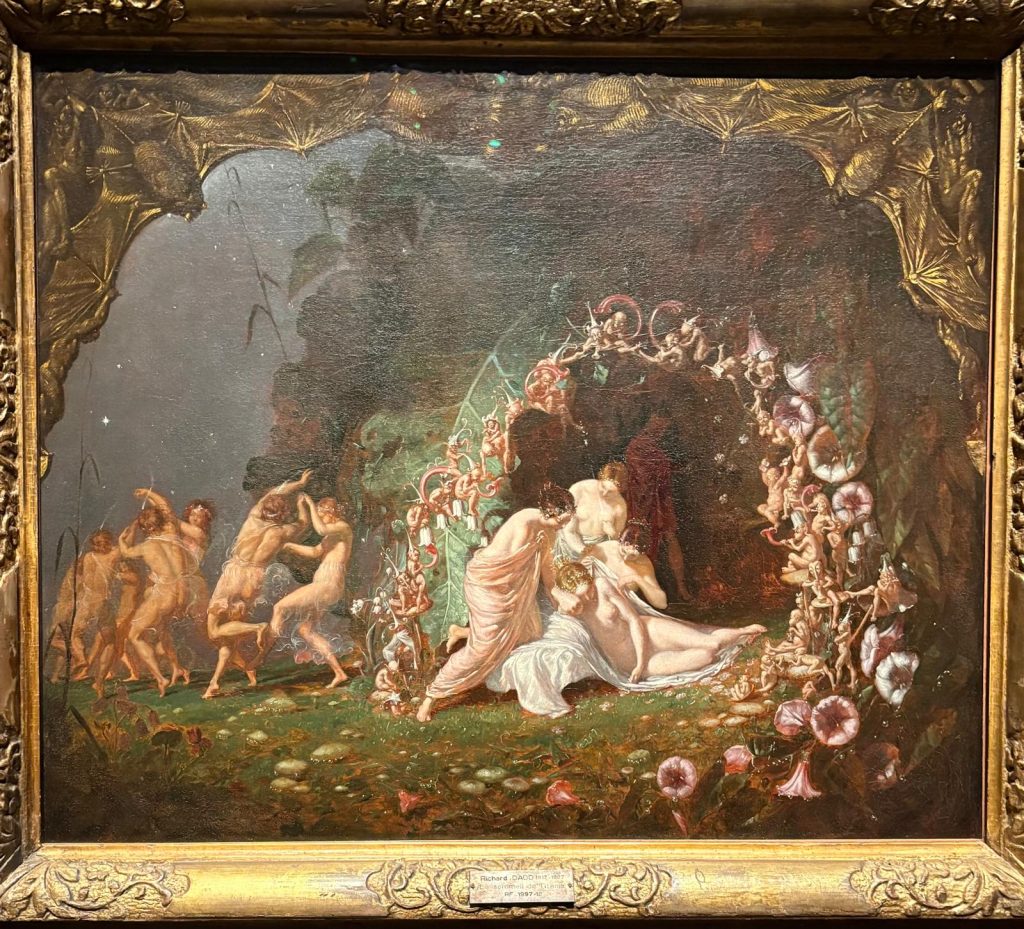
As Chair of Maudsley Charity, I was invited to the Royal Academy’s exhibition ‘Beyond Bedlam’, exploring the life and work of Richard Dadd.
Best known today for his extraordinary paintings, Dadd experienced a psychotic episode while travelling through Egypt, Syria and North Africa before returning to England, where he tragically killed his father. It is now widely believed that he was living with paranoid schizophrenia. He was admitted to Bethlem Hospital and later transferred to the newly opened Broadmoor.
Treatment today means Dadd would almost certainly not have spent more than forty years in institutions, and it is impossible not to reflect on how far we have come in supporting people experiencing psychosis. We still have much further to go. What particularly struck me was the extent to which he was encouraged to continue making art. He was given space, materials and support to create extraordinary works. Members of staff commissioned paintings, sat for portraits and recognised his talent rather than allowing his illness to become his defining characteristic.
One exhibit especially stayed with me. In the 1860s Dadd was commissioned to design certificates recognising hospital attendants who demonstrated exceptional care towards patients. It was a powerful reminder that compassion, dignity and humanity were already being recognised as central to good mental health care.
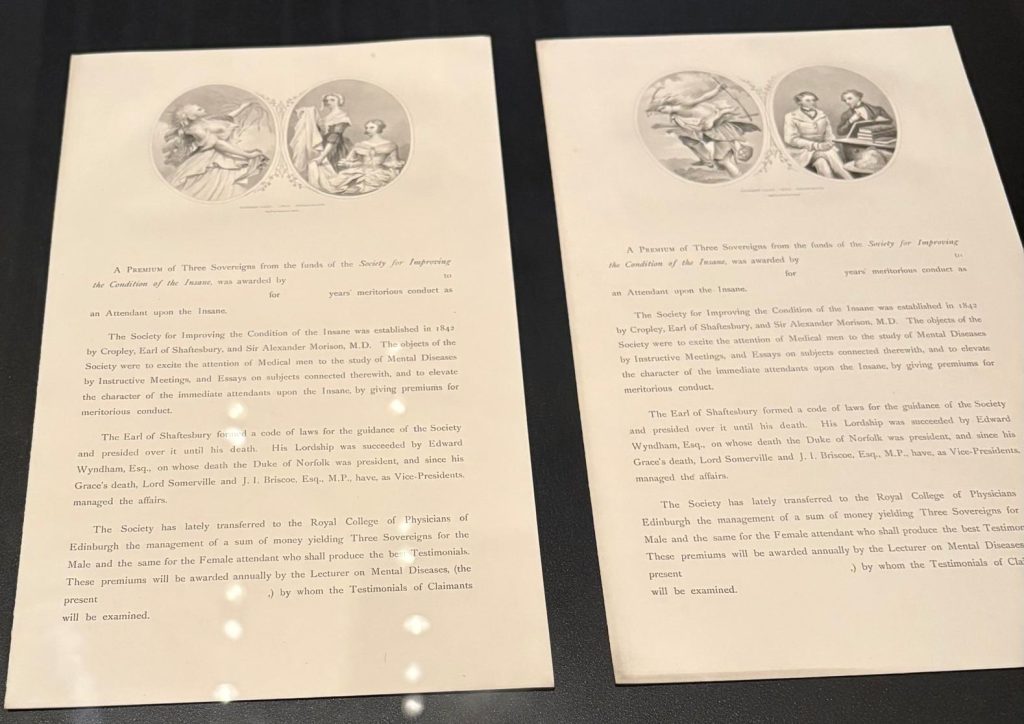
Richard Dadd’s certificate designs recognised hospital attendants who demonstrated exceptional care towards patients. They reflect an early understanding that compassion and dignity were central to mental health care.
How people were treated mattered.
But it was Dadd’s work itself that I found most compelling. The exhibition succeeds because it places his art alongside his experience of mental illness without allowing one to eclipse the other. His technical brilliance, extraordinary imagination and ability to conjure entirely different worlds remain firmly at the centre.
As a child, like many of my generation, I spent hours immersed in Arthur Rackham’s fairy tale illustrations. They suggested another world existed just beyond our own: fascinating, mysterious, unsettling and endlessly absorbing. Looking at Dadd’s paintings brought that feeling back.
His fairies are not sentimental creatures. They possess ambiguity, darkness and power, inviting us to imagine worlds that exist alongside our own.
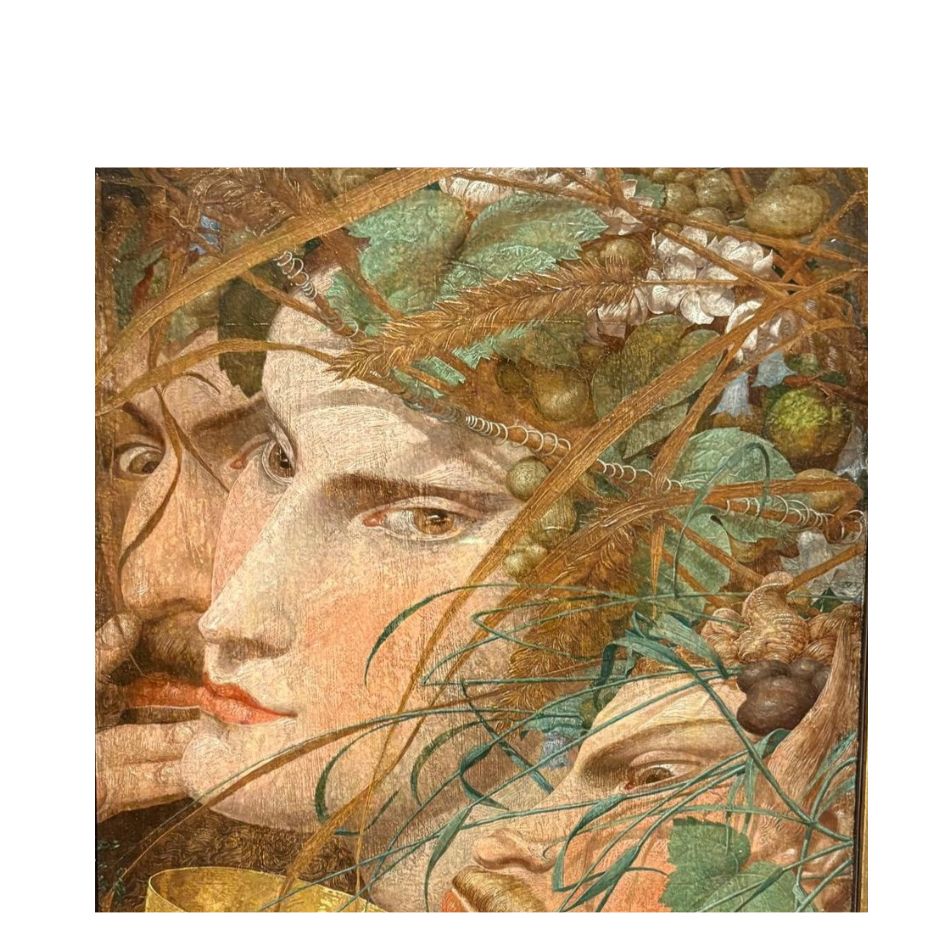
Richard Dadd, Contradiction: Oberon and Titania (detail).
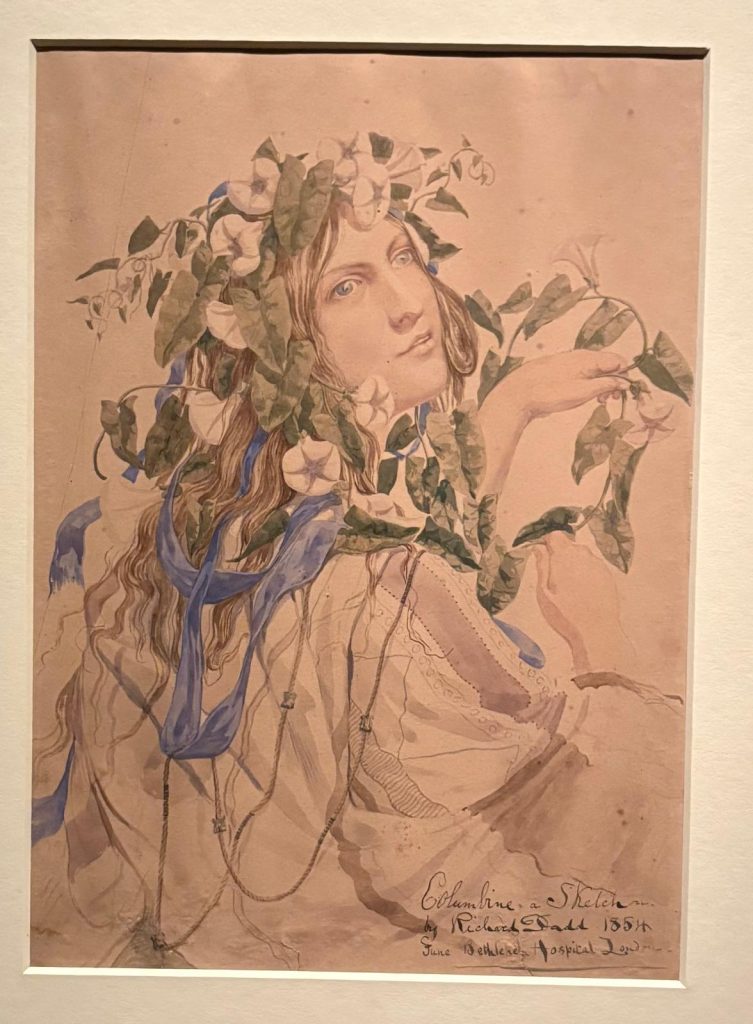
Richard Dadd, Columbine (1854). Created while Dadd was at Bethlem Hospital, this delicate watercolour demonstrates both his remarkable technical skill and his enduring fascination with literature, theatre and the natural world.
The Fairy Feller’s Master-Stroke remains his most celebrated work, capturing the moment before Queen Mab’s carriage is fashioned from a hazelnut. It is remarkable that this singular painting later inspired creative figures as varied as Angela Carter and Freddie Mercury. Great art has a way of travelling across generations, speaking to people in very different ways.
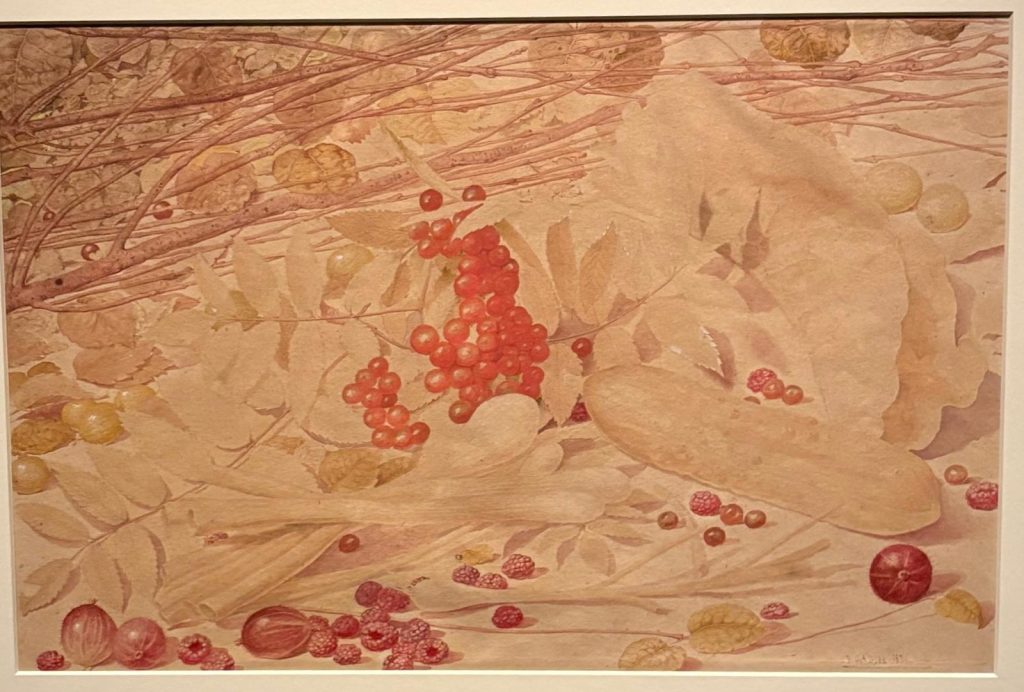
Richard Dadd, woodland study. Nature appears throughout Dadd’s later work, where leaves, berries and woodland become subjects of close observation as well as imagination.
What interested me most, however, was Dadd’s relationship with landscape. Following his move to Broadmoor he had greater access to views of the countryside, and his work increasingly reflected careful observation of trees, plants and the changing seasons. Nature is not simply a backdrop in these paintings; it is alive, shaping the emotional world of the work as much as the figures themselves.
Perhaps that explains why the exhibition resonated so deeply with me. It reminded me of walking in the Cumbrian landscape, where beauty, scale and wildness encourage both humility and imagination. There are places where mystery still feels possible; where lichens, stone, woodland and open skies invite us to see the world differently.
The exhibition left me thinking that our relationship with landscape is not simply aesthetic. It shapes our creativity, our wellbeing and our capacity to imagine different futures. At a time when conversations about the natural world are often framed in terms of crisis alone,
Dadd reminds us that nature is also a source of wonder, restoration and creative possibility.
That may be one of its greatest gifts.
Top image:Richard Dadd, Contradiction: Oberon and Titania.
Leave a Reply